
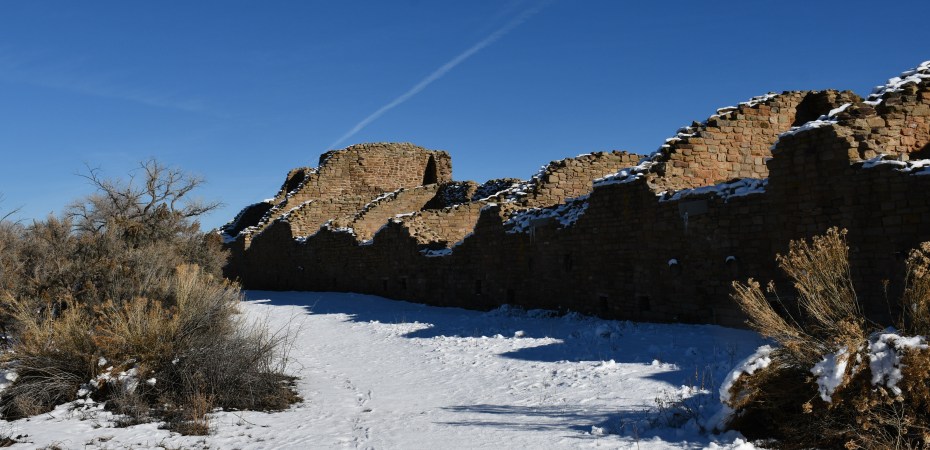
There are patterns that flow across the universe. These tiny clues beckon us towards a greater understanding. As a child growing up in remote eastern Utah, I was immersed in evidence of ancient ancestors. Arrowheads and potsherds were plentiful. People who grew up in Rome, Italy or Sophia, Bulgaria could say the same. However, the American Southwest is distinct because the physical connection between prehistoric archaeological sites and current civilization isn’t as clear. An absence of continuous residential timelines is why I believe we are so fascinated by the Puebloan Ancestor archaeological sites, such as Aztec Ruins National Monument.
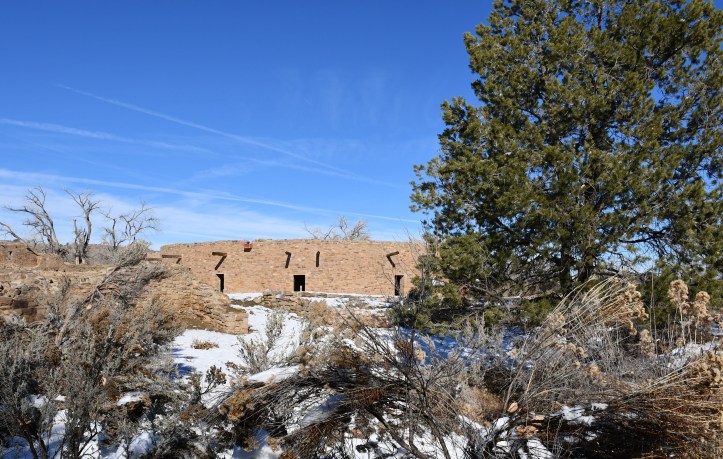
The ancient peoples of the American Southwest created complex and large settlements. Yet, when the Spanish arrived, most were vacant. That absence creates a disjointed understanding of how civilization progresses. We expect an establishment to grow, and be continuously inhabited. When it doesn’t, it holds for us a particular intrigue. We are left with the most human of questions. Where did they go?
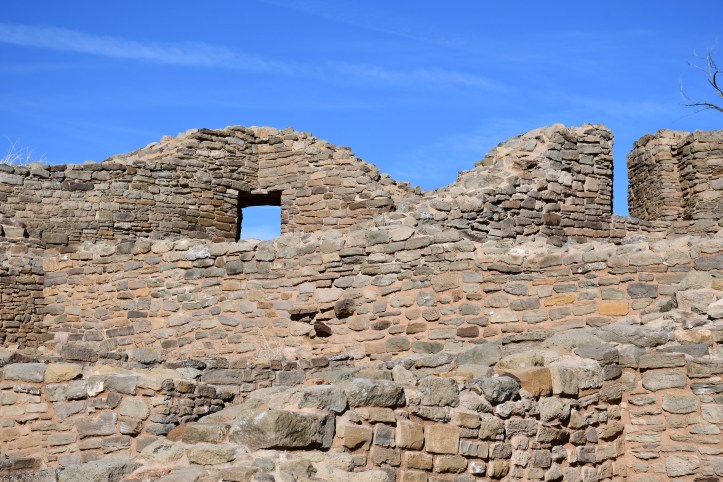
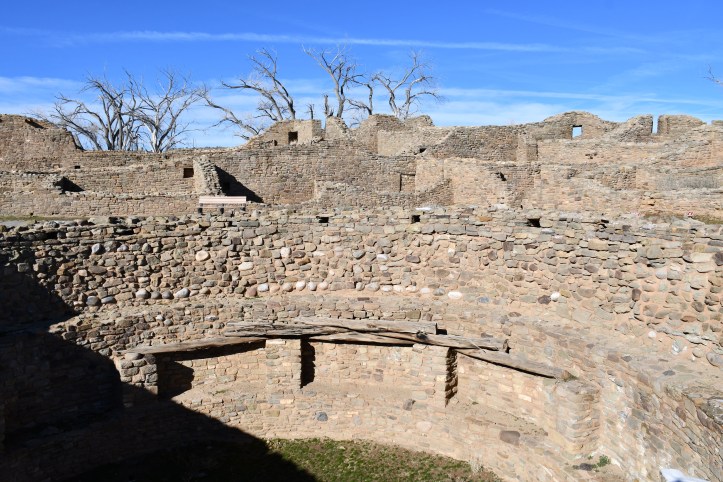
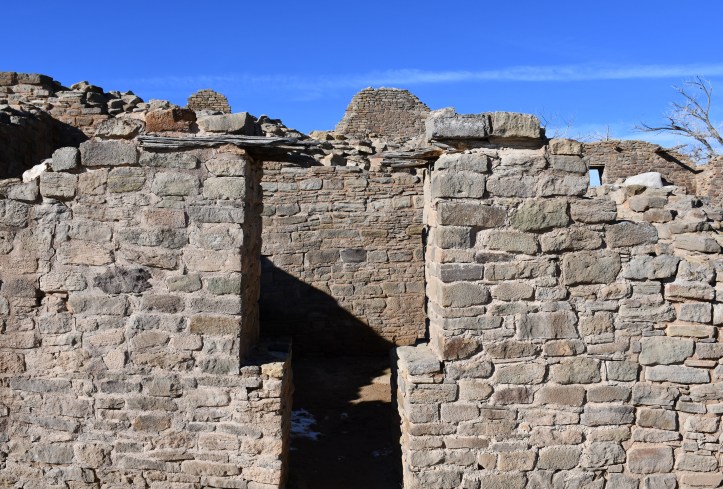
During our recent visit to Aztec Ruins National Monument, the kivas (circular, subterranean rooms), reminded me of beehives. They too are great establishments formed by substantial effort. Beehives, also, are not continuously inhabited, despite the enormous effort and materials bees use to construct them. For many reasons, bees may decide a particular hive location is no longer the most advantageous.
The pattern of beehive, kiva, and humanity’s flow through time demonstrate the circular nature of our beautiful existence. Sometimes, all that remains is the quiet evidence.
Take your children to Aztec Ruins National Monument to reflect, consider and contemplate human nature and our place in the natural world. It is a place to appreciate the abundant beauty of our shared human past in the Southwestern United States. It is a powerful place to introduce children to the idea that history exists not only within books, but physically around us.
Quick Guide to Aztec Ruins National Monument:
Location
Aztec, New Mexico in far north-western New Mexico
Best for:
Families, Junior Rangers, lovers of pre-history and archaeology
Time Needed:
1-3 hours
Stroller Friendly:
Yes (paved loop trail)
Restrooms:
At Visitor Center
Junior Ranger Program:
Yes
Is Aztec Ruins National Monument Good for Kids?
Yes, especially when you visit during comfortable weather. Young children may struggle to enjoy the archaeological site during hot, sunny days. When the temperatures are mild, this site truly shines for families.
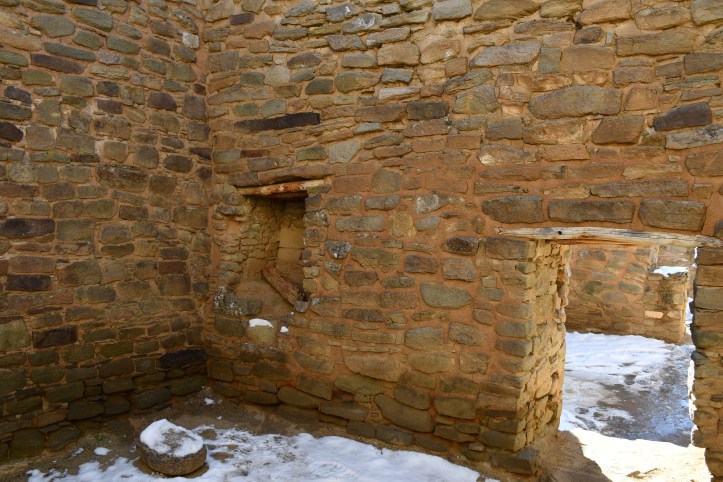
The monument is highly accessible for children, with a paved walking loop and open spaces to explore. Everyone must stick to the paved path to prevent damage to the site. Kids will enjoy fitting through doorways that feel just their size. Encourage them to imagine what life here would have been like: where people slept, cooked and gathered. This provides an exceptional opportunity for them to use imaginative play rooted in archaeology. Exploring and learning tactile makes this site especially memorable for families exploring public lands together.
Extra Tips:
Purchase the Aztec Ruins Trail Guide in the Visitor Center: For $3.00, you can purchase a trail guide that provides detailed readings for each numbered stop within the site. The guide provides interpretive information, and also personal reflections from modern-day descendants of the Ancestral Puebloans.
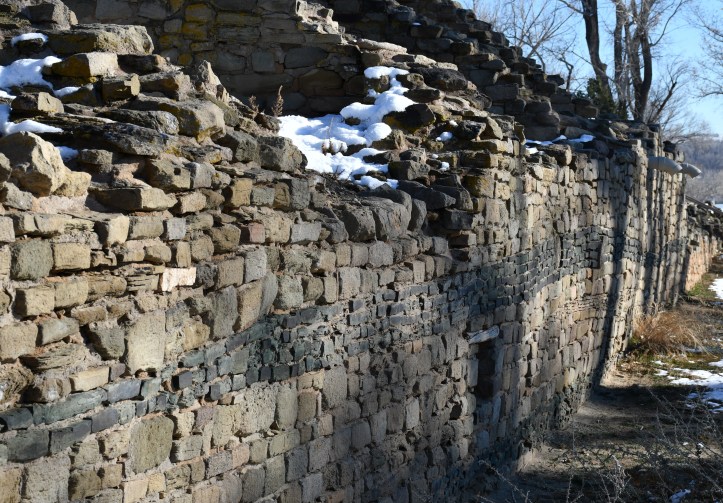
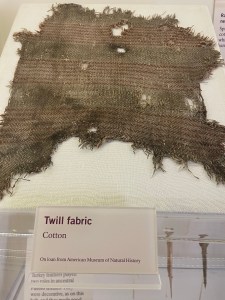
Artifacts: The Aztec Ruins Visitor Center is filled with extraordinary artifacts made with exquisite workmanship. The pottery, as always, is especially beautiful. However, it was the woven items I found most compelling. Due to the unique dry climate, woven mats and sandals were remarkably well preserved. Most intriguing were the intricate cotton textiles.
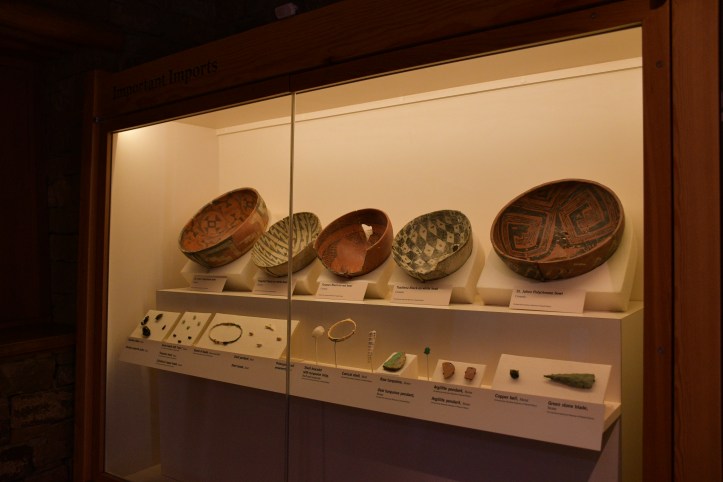
Visit Other Sites: A drive down the Animas River Valley along Highway 550 from Durango, Colorado, is especially scenic.
This National Monument should be visited in conjunction with other Ancestral Puebloan sites in the area, all around a 2-hour drive or less:
- Mesa Verde National Park
- Chimney Rock National Monument
- Hovenweep National Monument
- Canyon of the Ancients National Monument
- Chaco Culture National Historic Park
Junior Ranger Badge:
There are several age-based Junior Ranger activity pamphlets available at the Visitor Center.
As an ardent supporter of our Junior Ranger Programs, I was thrilled to discover the National Park Junior Ranger Podcast on our drive to Aztec Ruins National Monument. The episode on Aztec Ruins provided an exceptional overview, plenty of detailed information for parents and children, insightful history, and excellent tips. This quickly became one of our favorite ways to prepare for a park visit, and is appropriate for all ages. We will absolutely be enjoying these podcasts en route to national park sites in the future.
Remember:
Always check road conditions prior to travel in this area, as these locations are typically accessed by personal vehicle. Smaller towns and communities are interspersed between long stretches of open road, making preparation especially important when traveling with children. Please avoid travel during winter weather advisories.
Also, if combining this national park site with others, always check for closures and visiting hours on government park websites.
Where to Eat:
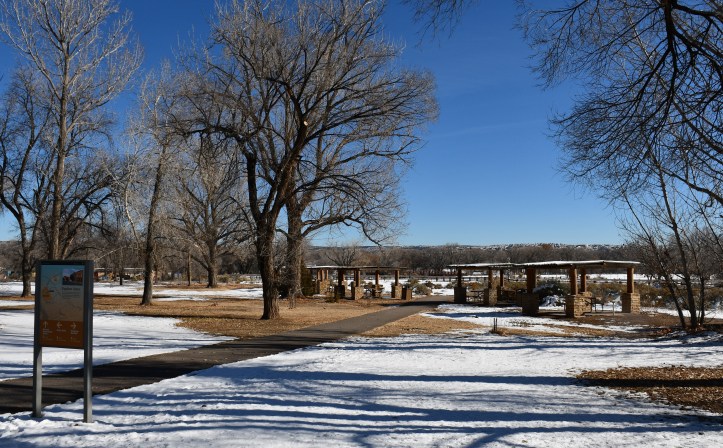
There are several food establishments in Aztec, New Mexico. The best way to enjoy this location is to bring your own lunch and make use of the picnic tables nestled beneath the cottonwood trees along the Animas River at the National Monument. It is a peaceful setting and a perfect place for everyone to decompress after arriving from a road trip.
When to Go:
The best time to visit is mid-fall when the cottonwood trees reach their peak enchanting shades of yellow. Summer temperatures can become uncomfortable, and the archaeological site itself is exposed to the sun. Winter may bring large snowstorms, making the paved walking path through the site inaccessible. However, we visited in mid- January, and only remnants of a recent snowstorm remained, set against a brilliant blue-sky. We wore jackets and were very comfortable outside.
Where to Stay:
If your preference is hotel accommodations, there are many options in Durango, Colorado. Tico Time River Resort RV Park is probably the most popular in the area. There are also campgrounds at nearby Navajo Lake State Park.
Ecology:
The Animas River flows adjacent to the archaeological site and continues to offer its quiet sustaining presence. This riparian corridor provides vital habitat for numerous plant and animal species, providing an opportunity to observe the natural world alongside human history.
While we were visiting, we used the Merlin Bird ID App, which we highly recommend as an engaging way to introduce children to the lifelong activity of birding. In just a few minutes, the app identified the calls of the American Goldfinch, European Starling, Cedar Waxwing, American Robin, White-crowned Sparrow, and Lesser Goldfinch. Connecting the sounds to images and names on the app is a powerful and simple tool that will help build scientific curiosity.
Visited January 2026

 National Park Adventures